Blessed are those who mourn, for they shall be comforted. [Matthew 5:4, NASB 1995]

μακάριοι οἱ πενθοῦντες, ὅτι αὐτοὶ παρακληθήσονται.[NA 28]
What comfort and consolation has been given to the people of God by our Saviour’s blessed words spoken on the mountain!
They are gone from the Passion ‘Translation’ (the inverted commas being a recognition that Simmons has almost certainly not in fact been translating at all, as I have argued previously):

What is going on? Brian Simmons claims in the first note that his first sentence is translated from ‘the Hebrew Matthew’:
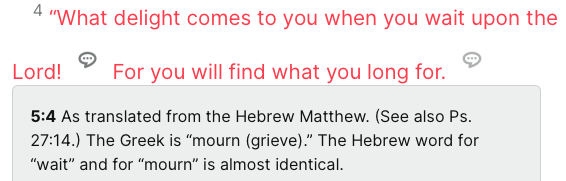
What does he mean by this? As is well known, there is evidence that Matthew may have written his gospel in Hebrew or, alternatively, may have written two versions, one in Hebrew and one in Greek. But if he did write a Hebrew version, it has been lost. The earliest known complete Hebrew version of Matthew appeared (p. ix) in a Jewish polemical treatise entitled אבן בוחן (Even Bohan) ‘The Touchstone’. The author, Shem-Tob ben-Isaac Ibn Shaprut, completed the work in 1380. 1 It exists (p. xi) in at least nine manuscripts, which date between the fifteenth and seventeenth centuries. An indication that it is this Hebrew Matthew that Simmons is referring to comes from a footnote in an earlier Passion ‘translation’ of Matthew, published in 2014 as ‘Matthew, Our Loving King’.
The term ‘Hebrew Matthew’ occurs 119 times in this work, and the first of these occurrences is in footnote [g] to Matthew 2:6:
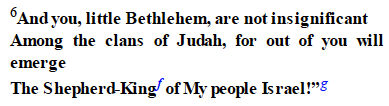

where ‘Hebrew Matthew’ is identified with ‘the Shem-Tob’, ie Shem-Tob’s Hebrew Gospel of Matthew. In passing, Simmons is incorrect in his claim that Shem-Tob’s version speaks of a King of Israel. The text reads (p. 6):

which George Howard translates as follows:

the last two words מושל בישראל meaning simply ‘ruler in Israel’ (מוֹשֵׁל (môšēl) being the masculine singular participle of מָשַׁל, (māšǎl) to ‘rule, govern’, commonly used as a substantive (noun) ie ‘ruler’), with no mention of a King. Neither does Micah 5:2 LXX speak of a King, but only of an ἄρχοντα ἐν τῷ Ισραηλ, that is, a ruler in Israel.
In a footnote to Matthew 8:28a, however, Simmons makes reference to another Hebrew Gospel of Matthew, namely that of Du Tillet:

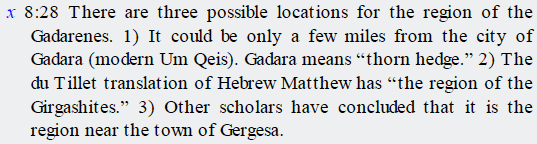
In 1553, Jean du Tillet, Bishop of Brieu, obtained (p. 3-4) from the Jews in Italy a manuscript containing the Gospel of Matthew in Hebrew, along with 23 objections to the gospel, also in Hebrew, and published it in 1555. He also commissioned (p. 3) a translation into Latin (not into English as implied in Simmons’ note). A translation into English by Hugh J Schonfield was published in 1927 and gives (p. 80) the location in Matthew 8:28 as ‘the country of the Girgashites’:

with footnote giving the Hebrew as גרגשיים. George Howard’s English translation (p. 34) of Shem-Tob’s version, on the other hand, has here ‘into the realm of the (Gaderi), that is, Ginitraros’, representing the Hebrew במלכות גַארְגְיזָאנִי נקראים בלעז גְיִיְנִיטרָ ארוֹס :

giving some indication of how different Shem-Tob’s text is from that of the Du Tillet manuscript.
In a footnote to Matthew 24:41, Simmons indicates that he considers there to be three ‘Hebrew Matthew’ manuscripts, one being that of Shem-Tob:

As explained above, Shem-Tob’s text is not a manuscript, but a version existing in several manuscripts. Leaving this point aside, there are indeed three (p. 161) prominent pre-modern Hebrew versions of Matthew, namely those of Shem-Tob and Du Tillet, along with that of Sebastian Münster, published in 1537. Whereas Du Tillet’s original manuscript is still extant, held (p. 6) at the Bibliothèque Nationale in Paris, Münster’s original manuscript is lost. According to Howard (p. 161), it had many lacunae which Münster restored, without marking the places where the lacunae had been, making his version of limited value. 2 In any case, no translation into English has been published, almost certainly making it inaccessible to Simmons.
With only two main alternatives to choose from, Shem-Tob and Du Tillet, it should thus be possible to determine, simply by trial and error, what Simmons means by ‘Hebrew Matthew’ in any particular footnote where he does not specify which version he is referring to. Such a procedure turns out to be required as Simmons does not specify what his Hebrew Matthew source text is, neither in an Introduction or Preface nor in the web-site FAQs.
In his introduction, Simmons suggests that Matthew may possibly have written his gospel in ‘Hebrew (Aramaic)’:
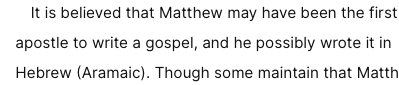
as if Hebrew and Aramaic were the same language! He then refers to ‘the Hebrew and Aramaic manuscripts’, without specifying which ones he has in mind:

Turning to the FAQs on the ‘Passion Translation’ web-site, Simmons claims, for the New Testament, to have been working from Nestlé & Aland’s Novum Testamentum Graece as his Greek ‘base text’, ‘while incorporating insights from the Syriac (Aramaic) Peshitta’:
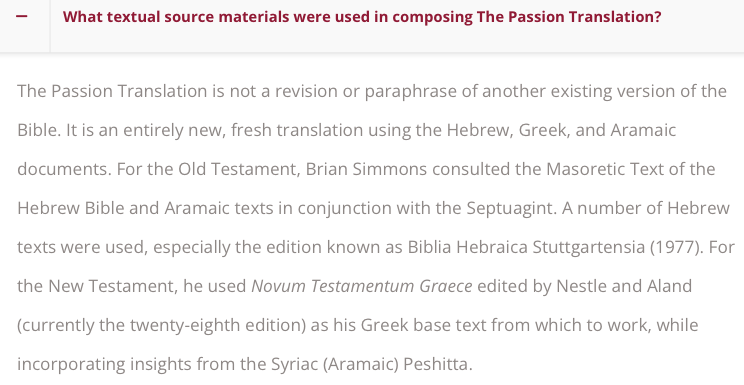
without any mention of a Hebrew text for any New Testament book.
Finally, Broadstreet Publishing make provision to ask them questions that are not answered in the FAQs:

Accordingly, I emailed them on 14 June 2026:
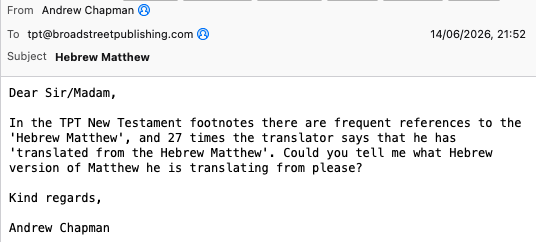
but have not as yet received a reply.
What remains is trial and error. Matthew 5:4, in Howard’s English translation of Shem-Tob’s version, reads (p. 17):

whereas Schonfield’s translation of Du Tillet’s edition reads (p. 62):

making it as certain as can be that Simmons is taking his idea of waiting rather than mourning from Shem-Tob’s version. The Hebrew is (p. 16):

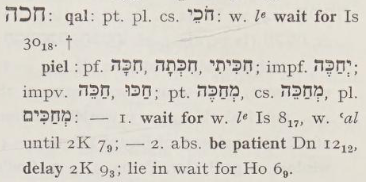
החוכים is the Qal masculine plural participle (plus the article) of חָכָה (ḥākhāl) meaning, in the Qal form, to ‘wait for’: 3
The masculine plural participle occurs, in the construct form חוֹכֵי, (ḥôkhēy) again together with אַשְׁרֵי ( ̓ǎšrēy; happy, blessed), in Isaiah 30:18d, where it takes an indirect object:
אַשְׁרֵ֖י כָּל־ח֥וֹכֵי לֽוֹ
blessed are all those who wait for him. [ESV]
It also occurs with אַשְׁרֵי (happy, blessed) in Daniel 12:12, this time as a masculine singular participle in the absolute state (in which its meaning can be ‘be patient’), without a grammatical object, but in the Piel form הַֽמְחַכֶּ֖ה (hā́mḥǎkěh; with the article הַ as prefix):
אַשְׁרֵ֥י הַֽמְחַכֶּ֖ה וְיַגִּ֑יעַ לְיָמִ֕ים אֶ֕לֶף שְׁלֹ֥שׁ מֵא֖וֹת שְׁלֹשִׁ֥ים וַחֲמִשָּֽׁה׃
Blessed is he who waits and arrives at the 1,335 days. [ESV]
Blessed is the one who is patient and attains to the 1,335 days! [NASB]
It does not occur, however, in Psalm 27:14, which Simmons references in his footnote:

and which reads:
קַוֵּ֗ה אֶל־יְה֫וָ֥ה חֲ֭זַק וְיַאֲמֵ֣ץ לִבֶּ֑ךָ וְ֝קַוֵּ֗ה אֶל־יְהוָֽה
Wait for the LORD; Be strong and let your heart take courage; Yes, wait for the LORD. [ESV]
קַוֵּ֗ה (qǎvvêh) being the Piel imperative masculine singular of קָוָּה (qāvvāh) meaning to ‘wait for (with implication of tenseness, eagerness)’ in the Piel form. 4
Would not someone who was really translating from Hebrew give a reference to a verse in which the same Hebrew word was used?
Evaluation of Shem-Tob’s Matthew
In 1987, George Howard, Professor of Religion at the University of Georgia, published ‘The Gospel of Matthew according to a Primitive Hebrew Text’, containing an edition of Shem-Tob’s Hebrew text of Matthew, along with an English translation, and a remarkable thesis that this text contained an ‘old substratum’ that was ‘an original composition, not a translation’:
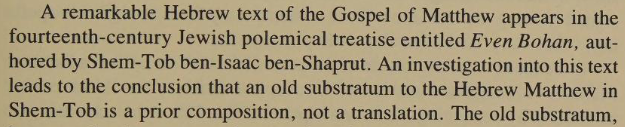
He claimed further that it was possible to distinguish which parts of the texts were from the original composition, and which were later revisions:
He did not believe that Greek Matthew is a translation of Hebrew Matthew, but that there were two compositions, one in Hebrew and one in Greek:

with the former probably serving as a model for the latter:


This thesis was starkly rejected by William L. Petersen, Assistant Professor of Early Church History and Patristics at the University of Notre Dame, Indiana, beginning his review in the Journal of Biblical Literature with ‘Interesting, yes; “primitive,” no.’:

and concluding that Shem-Tob’s Matthew is a secondary work, based on earlier medieval traditions:

By 1995, Howard had abandoned his thesis, even changing the title in the 2nd edition to ‘Hebrew Gospel of Matthew’, thus removing the reference to a primitive text. All reference to an ‘old substratum’ and an ‘original composition’ is gone from the Summary and Conclusion, and he finds that there is ‘little or no relationship’ between Shem-Tob’s Matthew and the Hebrew/Aramaic Matthew preserved through allusions and quotations by Irenaus, Origen, Eusebius, Epiphanius, Jerome and others:

Does Simmons disagree with Howard’s revised position, and if so on what grounds? He appeals for an ‘unbiased look at the Hebrew and Aramaic manuscripts’, but it could hardly be suggested that Howard would have been biased against his own earlier thesis.
In an Appendix to Matthew 19-28 (2004), the 3rd volume of the International Critical Commentary on Matthew, William Horbury examines some of the characteristics of Shem-Tob which had caused Howard to argue for it containing vestiges of an original Hebrew composition, and provides alternative explanations:

One of Horbury’s reasons for doubting an original composition in Hebrew is that ‘Eastern Jews, including very many in Palestine and Syria, spoke Aramaic’, not Hebrew: 5
More favourable circumstances for a Hebrew Gospel would emerge in the fourth to fifth centuries, when Jewish use of Hebrew began to increase:


But much in Ibn Shaprut’s (Shem-Tob’s) Hebrew Matthew pointed to medieval origin:

In a 2022 paper in Revue des études juives, José-Vicente Niclós Albarracín argues that Shem-Tob’s Hebrew Matthew is a translation from Catalan language:

from Provençal language:
from a Provençal recension of the Latin Vulgate:
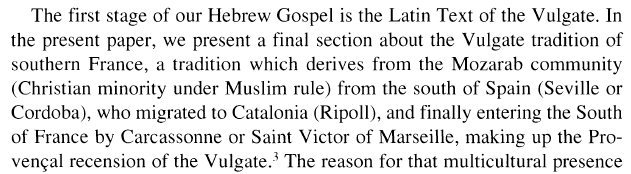
while the Vulgate gospels were translated by Jerome in the 4th century from the Vetus Latina, which was, for the New Testament, a translation from Greek.
We may conclude this evaluation of Shem-Tob’s Matthew by drawing attention to the 23rd verse of the first chapter: 6


As Petersen asked (p. 725), if this is an original Hebrew composition, rather than a translation, why is there a need to explain the meaning of Emmanuel?
Hebrew words for ‘wait’ and ‘mourn’
Simmons concludes his first footnote on Matthew 5:4 with the statement that ‘The Hebrew word for “wait” and for “mourn” is almost identical’:

Simmons’ English grammar is not correct. Since there are two words in view, plural forms should be used, thus: ‘The Hebrew words for “wait” and for “mourn” are almost identical.’
What would it mean for two Hebrew verbs to be ‘almost’ identical? They normally contain only three consonants. If all three are the same, then they would I think be identical in form, even if a lexicon might distinguish them according to meaning. If only two are the same, then they would be substantially different.
Why does Simmons imagine that there is only Hebrew word whose meaning could be expressed in English as ‘wait’, and one as ‘mourn’? Certainly for myself, as something of a beginner in reading the Hebrew bible, I expected that there would be several such words in each case, and this expectation turned out to be justified, as I detail below.
Why does Simmons not simply specify what Hebrew words he has in mind?
What is his point? My best guess is that he is suggesting that Matthew was written in Hebrew, and that a translator into Greek mistook חָכָה (ḥākhāh), meaning ‘wait, wait for’ for an ‘almost identical’ word meaning ‘mourn’, with the result that the people of God have been suffering from a deficient text for nearly two thousand years, until the happy release of the Passion ‘Translation’. Let us see whether this is possible.
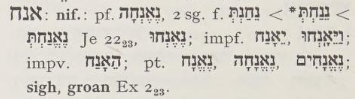
I have searched NASB, NIV and KJV concordances for words translated ‘mourn’, ‘mourns’ or ‘mourned’ and found the following nine verbs. For completeness’ sake, I have included words which can mean ‘mourn’ in some form other than Qal, even though in principle it would only be the Qal form that would be relevant. The definitions are from Holladay’s ‘Concise Hebrew and Aramaic Lexicon of the Old Testament’.
אָבַל (āvǎl)
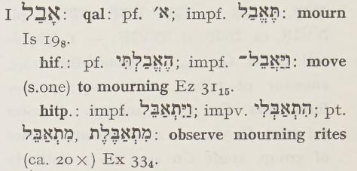
אָנָה (ānāh)

אָנַח (ānǎḥ)
בָּכָה (bākhāh)
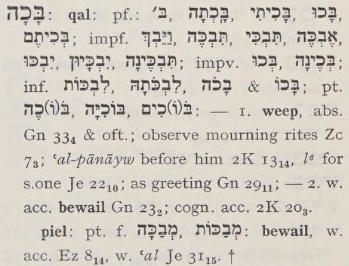
דָּאַב (dā ̓ǎv)

נָהַה (nāhǎh)

נוּד (nūd)
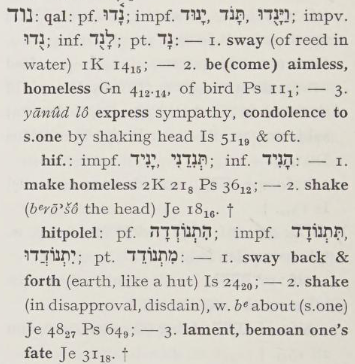
סָפַד (sāfǎd)
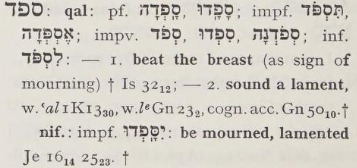
קָדַר (qādǎr)
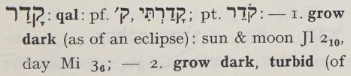
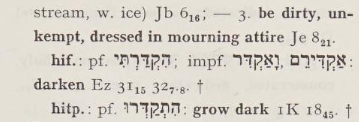
The only one of these at all similar to חָכָה (ḥākhāh), meaning ‘wait, wait for’, is בָּכָה (bākhāh), meaning ‘weep’. Howard contends that the Greek translators may indeed have mistakenly read הבוכים for החוכים :

Personally, I think it unlikely that ח (chet) would be mistaken for ב (bet), but it may be admitted as a possibility.
In case there is some other Hebrew word meaning ‘wait’ that is ‘almost identical’ to a word meaning ‘mourn’, and some other reason why Simmons is giving us this supposed information, I have searched for these also in the concordances and found the following seven words:
אָרַב (ārǎv)
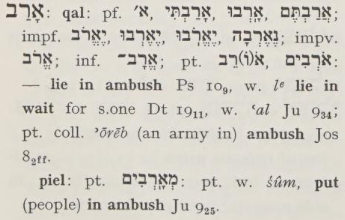

יָחַל (yāḥǎl)
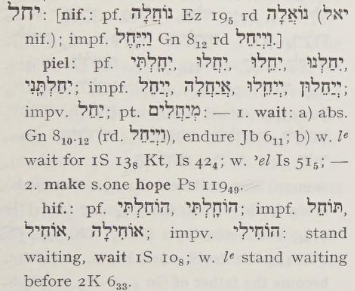
צָדָה (ṣādāh)

צָפָה (ṣāfāh)

קָוָה (qāvāh)
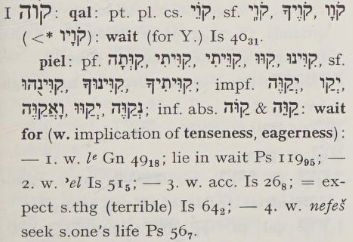
שָׂבַר (śāvǎr)
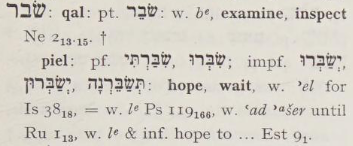
שָׁרַת (šārǎt)
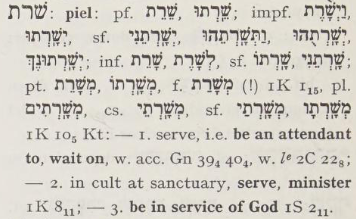
A comparison of the ‘mourn’ words with the ‘wait’ words:

shows that none of the former are at all similar to any of the latter, and I conclude that there is no sound basis for Simmons’ claim about two ‘almost identical’ words meaning ‘mourn’ and ‘wait’. If he has בָּכָה (bākhāh) and חָכָה (ḥākhāh) in mind, he should make that clear. They cannot reasonably be said to be ‘almost identical’, but it is the case that Howard conjectured that they could have been mistaken for one another. 7
In conclusion, there seems to be no good reason for preferring Shem-Tob’s fourteenth century Matthew as a source text to Greek editions based on manuscripts dating back to the fourth century. The great preponderance of scholarly opinion is that it is a translation, whether of Greek, or Latin, or Provençal/Catalan. The difficulty with the theory that it represents an unbroken chain of manuscripts and versions since an original Hebrew composition is that nothing has survived between that original manuscript, if it existed, and the fourteenth century. Even if vestiges of an original have survived, how could it be reliably determined whether a particular word or verse is original?
It should be observed also that Simmons’ first sentence: ‘What delight comes to you when wait upon the Lord!’ would not be a correct translation of: אשרי החוכים, which simply means: ‘Blessed are those who wait’, as in George Howard’s translation. To ‘wait’ means to remain for a time in a place or situation, with expectancy of a future event, whereas to ‘wait upon’ someone means to be in attendance upon someone. The addition of an object for the verb, namely ‘the Lord’, stems only from Simmons’ imagination.
‘nethbayoon’
If Simmons were translating from Shem-Tob’s Hebrew text:
אשרי החוכים שינוחמו
then there would only be one further word, שינוחמו, to translate. This is the third person masculine plural imperfect of נָחַם (nāḥǎm) in the Pual form, in which it has the meaning ‘be comforted’, along with the relative particle שֶׁ (šě) prefix, so: ‘who shall be comforted’. Howard’s ‘for they shall be comforted’ is perhaps acceptable, although it seems to me that he is introducing the causal sense ‘for’ from the Greek causal particle ὅτι in the Greek text, rather than from his Hebrew text. The verse, here with Howard’s rendering:

does not make easy sense. It seems a little odd for ‘wait’ to stand on its own without any sense of what these blessed ones are waiting for. And while waiting can be hard, it is true, is it comfort we need, or patience? These slight difficulties are another reason to reject Shem-Tob’s Hebrew as the true text. ‘Blessed are those who mourn for they shall be comforted’, on the other hand, does make perfect and beautiful sense.
But if Brian Simmons truly believes that the Shem-Tob text is best then he should translate the whole verse from that text. Instead, he makes a dramatic reversal two thirds of the way through and becomes, as it were, in a millisecond, an Aramaic primacist rather than a Hebrew primacist. In a note, he claims to be translating the last clause from Aramaic rather than from Hebrew!
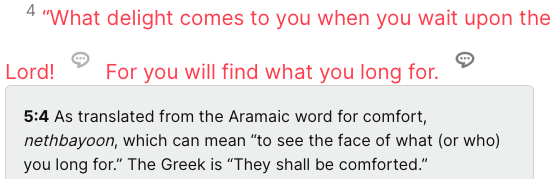
It is clear from the Passion ‘Translation’ FAQ:

that when Simmons claims to be translating from Aramaic, it is from the Syriac Peshiṭta, which reads in Matthew 5: 8


or in Hebrew script:
טוּבַיהוּן לַאבִילֵא דּהֵנוּן נֵתבַּיאוּן [Matthew 5:4, BFBS/UBS Peshiṭta text]
or transliterated (left to right; ə is an implied shewa, a short ē sound): 9
ṭūvayhūn lavīle dəhenūn netbaywūn
ܛܽܘܒ݂ܰܝܗܽܘܢ (ṭūvayhūn) is a noun meaning ‘happiness, blessedness’. It is in the construct state with third person plural masculine pronoun suffix (‘blessedness of them’). Jennings, p. 85:

ܠܰܐܒ݂ܺܝܠܶܐ (lavīle) is the third person masculine plural participle of ܐܒܠ (eval; ‘to mourn, grieve’), with lāmad prepositional prefix, i.e. ‘to those mourning’. Jennings, p. 13 (Serṭā script):

ܕ݁ܗܶܢܽܘܢ (dəhenūn) is the third person masculine pronoun with dālat relative particle prefix, i.e. ‘who (they)’. Finally,
ܢܶܬ݂ܒ݁ܰܝܐܘܽܢ netbaywūn is the third person imperfect masculine plural of ܒܝܐ (vaya) in its Ethpa ̔el form, in which it means ‘to be consoled, comforted’; so, ‘they will be comforted’. The leading scholarly Syriac lexicon is that of Michael Sokoloff (2009), and its entry for ܒܝܐ is:
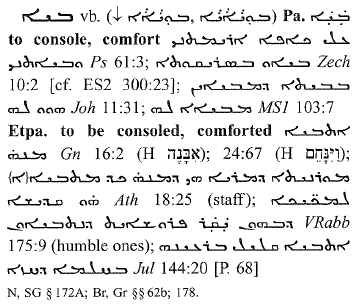
Likewise, the Compendious Syriac Dictionary gives the meaning in the Ethpa ̔el as ‘be comforted, receive comfort’:
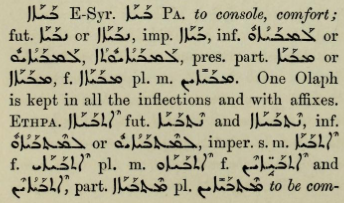

and Jennings’ Peshiṭta Lexicon gives ‘was comforted’: 10
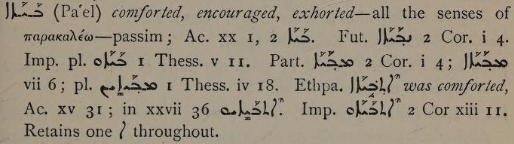
Accordingly, a recent scholarly translation of the Peshiṭta Matthew renders 5:4 as: 11

From whence, therefore, does Simmons obtain the idea that ‘nethbayoon can mean “to see the face of what (or who) you long for”‘? Three preliminary comments may be in order. First of all, ‘nethbayoon’ is a poor transliteration of ܢܶܬ݂ܒ݁ܰܝܐܘܽܢ (netbaywūn). Second, it would hardly be proper to use the third person masculine plural imperfect form ܢܶܬ݂ܒ݁ܰܝܐܘܽܢ (‘they will be comforted’) to give the meaning of the word, rather than a third person masculine perfect form, as is conventional in the lexicons. Third, the Ethpa ̔el is a passive form, so it is hard to see how it could have an active meaning like ‘to see the face of’.
Jim DeFrancisco
A web search for the word ‘nethbayoon’ revealed with high probability the source of Simmons’ claim. In an unpublished and undated paper hosted on his academia.edu page, James DeFrancisco states, first, that ‘nethbayoon means “comforted”‘:

As explained above, the transliteration is imprecise, and the meaning of ܢܶܬ݂ܒ݁ܰܝܐܘܽܢ (netbaywūn) is ‘they will be comforted’. DeFrancisco, according to his C.V., holds an M.A. (1988) in Biblical Studies from Baptist Christian University in Shreveport (later, Louisiana Baptist University, now LBU Global), and a PhD (1992) in Biblical Counseling, along with a D.Min. (2004) in Christian Counselling, both from the America Christian College and Seminary (formerly University of Biblical Studies and Seminary), Oklahoma City. Since 1990 he has been associated with organisations that hold to Aramaic primacy of at least parts of the New Testament. Dr DeFrancisco does not believe that the apostle Paul’s letters should be considered to be Holy Scripture:

The only indication that he has studied Syriac is that in 1992 he took a course in ‘Ancient Classical Aramaic language’ at the Noohra Foundation:

He contends that the mourning ones of Matthew 5:4 are those who were deeply grieved by their social and political conditions:

They were to be comforted through a ‘return from wandering’, an ‘internal unity through love’, and ‘seeing the arrival of.. what or who is longed for’:

Since there is nothing in the text about the arrival of anything or anyone, it is hard to see how there could be any sort of ‘literal meaning’ of something as indicated in the parenthesis.
The mourners ‘are comforted’ (present tense) in DeFrancisco’s understanding by the realisation that the promised Messiah has now arrived:


He does not provide a translation, but the idea seems to be: ‘Blessed are those who are mourning (longing for the Messiah), because they are being comforted (by seeing the Messiah, the one they have been longing for).’ The Syriac imperfect can have a present continuous force, so this may be a defensible, if perhaps idiosyncratic, understanding of the Peshiṭta text. It is not a viable interpretation of the Greek text, since παρακληθήσονται is definitely future: ‘they shall be comforted’.
Simmons then plucks this interpretation of the text out of its context of the arrival of the Messiah, and applies it to anything or anybody that somebody may be longing for. He also applies it to those who are waiting, rather than those who are mourning. He makes it future, rather than present, as I think it has to be in DeFrancisco’s interpretation. Finally, he changes ‘see’ to ‘find’, apparently arbitrarily.
DeFrancisco does not say that ‘nethbayoon’ actually means ‘to see the arrival of, or the face of’ something or someone. This is clearly an interpretation of what he believes it ‘signifies’ in context. Even if he were correct in his interpretation, and even if he were a reliable authority on the Syriac language, this would not justify Simmons claiming that ‘nethbayoon’ can ‘mean’ to ‘see the face of’ something or someone.

Conclusions
Matthew 5:4 is a single sentence in all the Greek manuscripts, in Shem-Tob’s medieval Hebrew Matthew, and in the Syriac Peshiṭta. In Hebrew, it contains only three words: אשרי החוכים שינוחמו, meaning (rather literally) ‘Happy (or blessed) are the waiting ones, who will be comforted’. To form his first sentence, Brian Simmons has supposedly translated the first two words of the Hebrew text, that is, אשרי החוכים, ‘Happy are the waiting ones’, to arrive at his first sentence: ‘What delight comes to you when you wait upon the Lord!’ He has mistranslated the participle as if חָכָה (ḥākhāh) meant ‘wait upon’ rather than ‘wait for’, and he has invented an object, that is, the Lord.
His claim that the Hebrew words for ‘wait’ and for ‘mourn’ are ‘almost identical’ appears to be without foundation. His reference to Psalm 27:14, where a different Hebrew word meaning ‘wait for’, קָוָּה, is used, rather than Isaiah 30:18, where חָכָה is used in the Qal form, or even Daniel 12:12, where it is used in the Piel form, tends to suggest that Simmons is not in fact translating from Ben-Tob’s Hebrew Matthew, but incorporating ideas from an English translation of the same.
Bizarrely, having begun with Shem-Tob’s Hebrew text (or almost certainly an English translation of the same), he breaks off half-way through the sentence he is supposedly translating, and turns instead to the Syriac Peshitta. He takes the last two words, ܕ݁ܗܶܢܽܘܢ ܢܶܬ݂ܒ݁ܰܝܐܘܽܢ (dəhenūn netbaywūn, ‘they who will be comforted’) and, by taking an idea out of context from a commentary on the Syriac text by an Aramaic primacist, James DeFrancisco, transforms these into his second sentence: ‘For you will find what you long for.’
Brian Simmons has put words into the mouth of the Lord Jesus which He did not speak, and taken away a precious promise which He has given to His disciples, namely that when we mourn we will be comforted. If, for example, we mourn for a loved one who has passed from this life on the earth, we may long to see them again. Jesus did not promise that we would see them again, as Simmons suggests. We trust that we will do so if they died in the Lord, but sadly not otherwise. He promised that we would be comforted. Even if we are not comforted by friends and family, or by obtaining what we long for, the Lord Himself will comfort us. But this blessed assurance is gone from what we may reasonably call the Passion Alteration.
Andrew Chapman
Notes:
- The Textual Nature of Shem-Tob’s Matthew; George Howard; Journal of Biblical Literature, Vol. 108, No. 2, (Summer 1989), p. 239. ↩
- In ‘The Hebrew Matthew and Hebrew Study’, p. 124-5, in ‘Hebrew Study from Ezra to Ben-Yehuda’ (1999), William Horbury interprets certain comments in Münster’s prefatory letter to his gospel to mean that his text had been divided into sections, rather than that it had lacunae. ↩
- Holladay, W.L. (1971) A Concise Hebrew and Aramaic Lexicon of the Old Testament; W.L. Holladay; 1971; Grand Rapids: Eerdmans; p. 103. ↩
- Holladay, p. 315. ↩
- Randall Buth has argued that in the 1st century ‘the mother tongue of the homeland was Hebrew’, specifically Mishnaic Hebrew, at least in Judea. Originally published in the Journal of Translation and Textlinguistics in 1992. ↩
- אלקים (Eloqim) stands for אלהם (Elohim), the substitution sometimes being made by Jews to avoid use of the divine Name. ↩
- It occurred to me, after finishing the article, that for completeness’ sake, I ought to search also for Mishnaic words that mean ‘mourn’, in case it was one of these that could have been confused with חָכָה. A search in the Compendious Hebrew-English Dictionary, which includes Mishnaic, medieval and modern Hebrew words, yielded two further words which can mean ‘mourn’ or ‘be grieved’, namely עָצַב (p. 278, but only in the Nifil form) and תָּאֵן (p. 398, Qal). Clearly, neither of these are similar to חָכָה. There are also eight further words which can mean wait, namely דוֹם and דָּלִיָּה and חוּל and כִּתֵּר and סִבֵּב and עִכֵּב and שִׂבֵּר and שִׁמֵּשׁ. The conclusion remains the same that none of the ‘mourn’ words are at all similar to any of the ‘wait’ words. ↩
- The Syriac Peshiṭta Bible: the New Testament; edited by Timothy A. Lee; based on the text edition of George A. Kiraz; 2023; Piscataway, NJ: Gorgias Press. ↩
- It appears to be standard practice not to transliterate ālap, which is quiescent and has no vocalisation outside of the vowel that is associated with it. ‘Basics of Classical Syriac’, Steven C. Hallam; Grand Rapids: Zondervan. pp. 15, 22. ↩
- He translates the third person masculine singular perfect literally, rather than using the infinitive, as is conventional in English dictionaries. ↩
- The Syriac Peshiṭta Bible with English translation: Matthew; translated by Jeff W. Childers; text prepared by George A. Kiraz; 2012. Piscataway, New Jersey: Gorgias Press. ↩
