Matthew 5:4 reads:
Blessed are those who mourn, for they shall be comforted. [Matthew 5:4, NASB 1995]

μακάριοι οἱ πενθοῦντες, ὅτι αὐτοὶ παρακληθήσονται.[NA 28]
In the Syriac Peshiṭta, it reads
 ܛܽܘܒ݂ܰܝܗܽܘܢ ܠܰܐܒ݂ܺܝܠܶܐ ܕ݁ܗܶܢܽܘܢ ܢܶܬ݂ܒ݁ܰܝܐܘܽܢ  [BFBS/UBS]

ṭūḇayhūn laḇīle dəhenūn netbayūn

Blessed are the mourners, for they will be comforted. [tr. Childers]
In ‘Matthew: Our Loving King’ (Passion ‘Translation’, 2014) however, Brian Simmons rendered this verse as follows:
What delight comes to you when you wait upon the Lord![d] For you will find what you long for.[e]
Footnote ‘e’ read:
As translated from the Aramaic word for comfort, nethbayoon, which means “to see the face of what (or who) you long for.” The Greek is “They shall be comforted.”
The first sentence seems nonsensical, since it is written as if ‘comfort’ and ‘to see the face of what (or who) you long for’ were both the single meaning of ‘nethbayoon‘ (netbayūn). Text and footnote remain in the current version of the Passion ‘Translation’, except that ‘means’ has been moderated to ‘can mean’, making the statement comprehensible at least. In fact, netbayūn is the third person imperfect masculine plural of ܒܝܐ (ḇaya) in its Ethpa ̔el form, so an English equivalent could be ‘[they] will be comforted’, as in Jeff Childers’ translation above.
In my last post, I proposed that the source of this first sentence of the footnote was a paper by Jim DeFrancisco, in which he writes:
NETHBAYOON means “comforted” signifying a return from wandering, an internal unity through love, a feeling of inner continuity, and seeing the arrival of (literally, “the face of”) what or who is longed for.
DeFrancisco acknowledges a debt to George Lamsa, Rocco Errico, and Neil Douglas-Klotz for ‘much of the background material’ for his paper:

Douglas-Klotz’s book Prayers of the Cosmos (1990) contains a kind of commentary or interpretation of the Peshiṭta version of The Lord’s Prayer and of the Beatitudes. Regarding netbayūn in Matthew 5.4, Douglas-Klotz writes (p. 51):

Netbayun can mean “comforted,” but also connotes being returned from wandering, united inside by love, feeling an inner continuity, or seeing the arrival of (literally, the face of) what one longs for.
It may be helpful to put Simmons’ rendering, his footnote, and the commentaries of DeFrancisco and Douglas-Klotz side by side in a table to show the extent of the connection between them:

I have adopted and adapted David Fish’s system of using red for words which may have been copied from another source, and green for ideas which may have been copied, but expressed in different words. I have used blue where there is exact or almost exact copying of words by DeFrancisco without their being copied by Simmons. Orange draws attention to a difference in transliteration. The fact that Simmons’ transliteration is the same as that of DeFrancisco, but different to that of Douglas-Klotz, is evidence that he is probably copying from DeFrancisco rather than Douglas-Klotz.
It can be seen that DeFrancisco has copied wholesale from Douglas-Klotz, with only minor alterations in the form of expression. There can be little doubt that Simmons’ claim in his footnote that netbayūn means ‘to see the face of what (or who) you long for’ comes from Douglas-Klotz, probably via DeFrancisco. From this claim he derives his strange rendering ‘For you will find what you long for’ in place of ‘for they shall be comforted’.
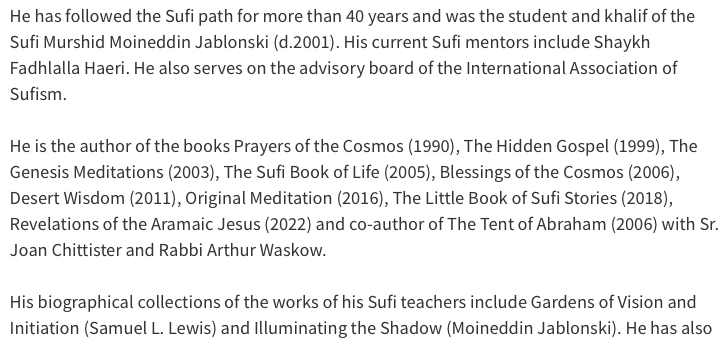
According to his academia.edu page, Douglas-Klotz, has ‘followed the Sufi path’ for more than 40 years:
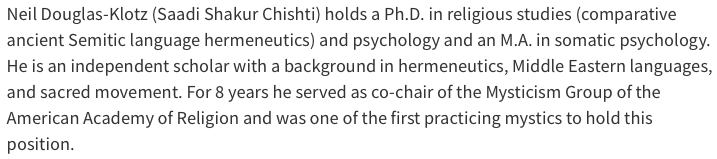
He served as co-chair of the Mysticism Group of the American Academy of Religion from 1998-2006, and describes himself as a mystic:
In Prayers of the Cosmos (p. 2), he described the Lord Jesus as ‘a Middle Eastern mystic’:

While he employed a scholarly Peshiṭta source text (pp. 4-5):


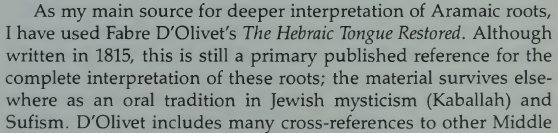
he derived meanings or rather, what he calls ‘deeper interpretation’ of the Syriac words from Fabré d’Olivet’s ‘The Hebrew Tongue Restored’ (p. 7):
According to the biographical article (authored by Arthur McCalla, then an Assistant Professor in the Departments of Philosophy/Religious Studies and History at Mount Saint Vincent University in Nova Scotia) in the Dictionary of Gnosis and Western Esotericism, 1 d’Olivet (1767-1825) believed that ‘Hebrew… was a hieroglyphic language that veiled deep esoteric truths’:


He drew upon (p. 121):

the theories of Court de Gébelin (1724/5(?)-1784), a Protestant pastor and later Freemason, best known today for originating the esoteric Tarot card tradition: 2

de Gébelin was initiated into Freemasonry in 1771, joining the Lodge of Les Amis Réunis, and in 1775 was one of the founders of the Philalèthes, which ‘combined almost every type of illuminist and occultic doctrine’:

In 1783 he was one of only seven members who had attained to the twelfth and highest degree. He also joined another Masonic Lodge, Les Neufs Soeurs, to which Voltaire and Benjamin Franklin belonged, becoming its Secretary in 1778. 3
In 1773, he published the first volume of Monde Primitif (Primitive World), which was largely devoted to linguistic investigations. His procedure was ‘wholly unscientific’ according to Michael Dummett, formerly (1979-92) Wykeham Professor of Logic at Oxford University, and his co-authors: 4
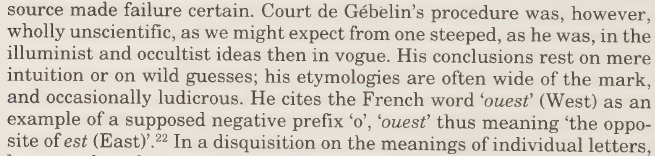
He assigned meaning to individual letters, with A, M & N representing Father, Mother and Child or new-born respectively:


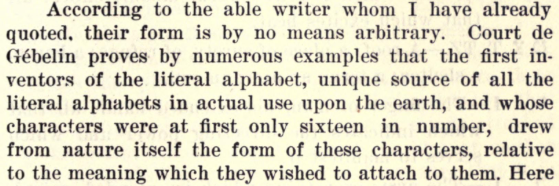
d’Olivet considered de Gébelin to have proved that the form of the individual letters was ‘by no means arbitrary’ but that our ancestors had drawn the form of the characters in accordance with the meaning they wished to attach to them (p. 91):
Thus, to take the same three letters as examples, which he calls ‘signs’ and associates with Hebrew letters with similar sounds, d’Olivet indeed represented de Gébelin as assigning to them the meanings Man, Woman and Child (p. 91-2):


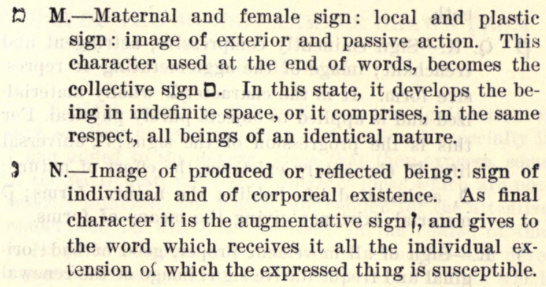
In some cases, including Mem (M) and Nun (N), d’Olivet retains de Gébelin’s basic idea, but develops it into a more abstract formulation (p. 97):
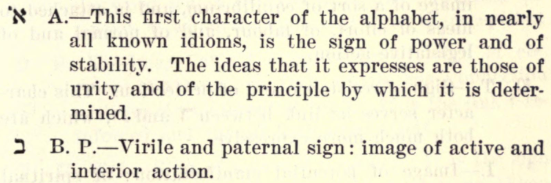
For d’Olivet, Alef (A) becomes the ‘sign of power and stability’, while it is Bet (B) that is the ‘virile and paternal’ sign:
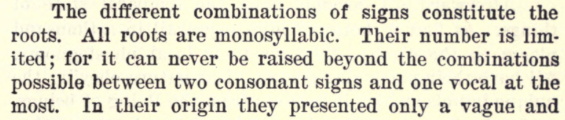
d’Olivet rejected the normal conception of Hebrew triliteral verbal roots, which most often have two syllables, and insisted that true roots can only have one syllable, with no more than two consonants:
It will now be shown how Douglas-Klotz derived his interpretation of a Syriac word in the Peshiṭta version of Matthew 5.6b from d’Olivet.
Matthew 5.6b
Matthew 5:6 reads:
Blessed are those who hunger and thirst for righteousness, for they shall be satisfied. [Matthew 5:6, NASB 1995]

μακάριοι οἱ πεινῶντες καὶ διψῶντες τὴν δικαιοσύνην, ὅτι αὐτοὶ χορτασθήσονται. [NA 28]
In the Syriac Peshiṭta, it reads
 ܛܽܘܒ݂ܰܝܗܽܘܢ ܠܰܐܝܠܶܝܢ ܕ݁ܟ݂ܰܦ݂ܢܺܝܢ ܘܰܨܗܶܝܢ ܠܟ݂ܺܐܢܽܘܬ݂ܳܐ ܕ݁ܗܶܢܽܘܢ ܢܶܣܒ݁ܥܽܘܢ  [BFBS/UBS]

ṭūḇayhon laylēn dəḵapnīn waṣhēn ləḵīnūṯā dəhennon nesbəᶜūn

Blessed are those who hunger and thirst for justice[2], for they shall be satisfied. [tr. Childers]

(Footnote 2: 'justice' or 'uprightness'.)
In ‘Matthew: Our Loving King’ (Passion ‘Translation’, 2014) however, Brian Simmons rendered this verse as follows:

with footnote [i] reading:

ܢܶܣܒ݁ܥܽܘܢ (nesbəᶜūn) is the third masculine plural imperfect of ܣܒܥ (Semkaṯ-Bēṯ-ᶜĒ, with ᶜĒ being the Syriac equivalent of the Hebrew letter Ayin) in the Pe’al form, in which it means ‘to be sated, have one’s fill’:
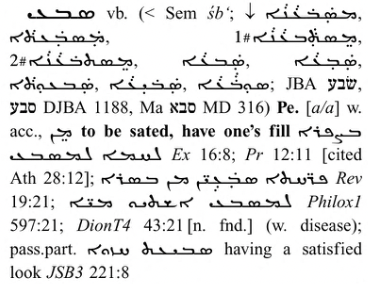
ܢܶܣܒ݁ܥܽܘܢ (nesbəᶜūn), therefore, means ‘they will be sated’, ‘they will have their fill’ or, perhaps slightly less literally, ‘they will be satisfied’. From whence, therefore, does Brian Simmons derive the notions of being ‘surrounded by fruitfulness’, and of planting? The answer, very probably, is that he is relying upon Jim DeFrancisco who, in his commentary on this verse, writes:

DeFrancisco has taken his commentary, as certainly as can be, from Neil Douglas-Klotz (p. 57):

As we learned above, Douglas-Klotz’s ‘main source for deeper interpretation of Aramaic roots’ was Fabre d’Olivet. The Hebrew equivalent of our verbal root ܣܒܥ (Semkaṯ-Bēṯ-ᶜĒ) would be סבע (Samekh-Bet-Ayin), which is not in fact a Hebrew word. Nevertheless, proceeding along the lines of d’Olivet’s system, we see that he, presumably from the shape of the character, claimed Samekh to be a sign of circular movement:

Beth, as shown above, was an ‘image… of interior action’:

Aleph, whose relevance will be explained shortly, was the sign ‘of power and of stability’:

Through the combination of power and interior action, the root Aleph-Bet carried the idea of generative force. In some languages at least, it could be applied to a ‘principle of universal fructification’, with ‘fructification’ meaning ‘the action or process of… producing fruit’:
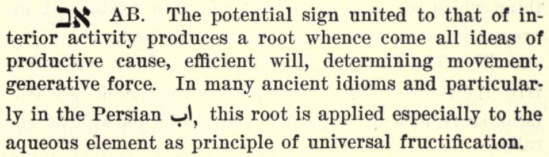
where ‘potential’ had the now rare meaning of possessing potency:

and ‘fructification’ had what is also now a rare meaning of ‘the action or process of.. producing fruit’:

For the supposed meaning of Samekh-Bet, it appears that d’Olivet allowed the combination of either Samekh with Bet itself, or Samekh with Aleph-Bet. (I have not yet found a place where he justifies such a procedure, but presumably he might have argued that, since Aleph is silent, Samekh-Aleph-Bet could naturally contract to Samekh-Bet.) When conceived as the product of Samekh and Bet alone, Samekh-Bet expressed ‘every idea of occasional force, cause, reason’; but when conceived as the product of Samekh with Aleph-Bet, ‘image of every conceivable fructification’, then ‘this root’, perhaps referring to Aleph-Bet, is ‘applied to that which surrounds, circumscribes, envelops’ (pp. 405-6):

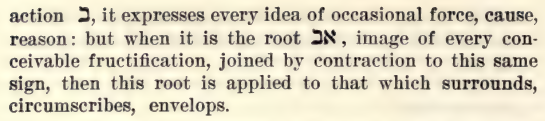
Applying fructification to that which surrounds could, not unreasonably, result in a meaning like Douglas-Klotz’s ‘surrounded by fruit’. A table may be helpful in showing the probable relationship between the work of d’Olivet, Douglas-Klotz, DeFrancisco and Simmons:
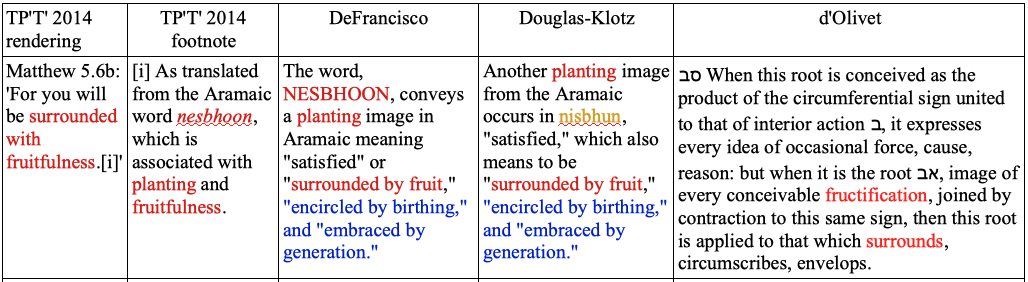
Given the distinctiveness of the Passion ‘Translation’ (2014) rendering, and the absence of any possible justification for it from known real meanings of the Syriac word ܣܒܥ, it must be concluded with virtual certainty, that it derived from Fabre d’Olivet.
d’Olivet was a theosopher: 5

and an Illuminist who reduced the Lord Jesus Christ to the same rank as Krishna, Odin and Apollonius of Tyana:
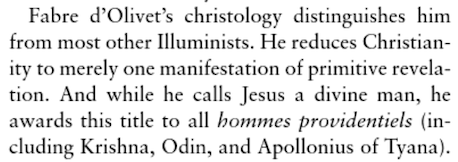
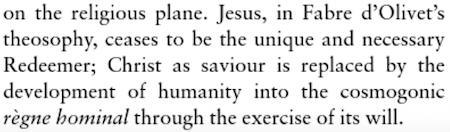
For d’Olivet, the Lord Jesus is neither Redeemer nor Saviour. Humanity is to develop until it rules the world or universe through the exercise of its will:
Brian Simmons allowed himself, no doubt unwittingly, to be influenced by this man’s ideas, and by those of a Sufi mystic, to change the text of holy scripture, indeed of the Lord Jesus’ holy teaching itself, to the detriment and confusion of trusting readers and hearers. Should we continue to allow his bible versions to be propagated in our midst?
Andrew Chapman
Notes:
- Dictionary of Gnosis and Western Esotericism (2005); ed. Wouter J. Hanegraff; Vol. 1; pp. 350-354; Leiden: Brill. ↩
- A Wicked Pack of Cards: The origins of the occult Tarot; Ronald Decker, Thierry DePaulis & Michael Dummett (1996); London: Duckworth; p. 52 ff. Dummett’s own book The Game of Tarot, contains much of the same material on de Gébelin at https://archive.org/details/game_of_tarot_part_1/page/102/mode/1up. ↩
- Wicked Pack; p. 55 ↩
- Wicked Pack; p. 56 ↩
- Dictionary of Gnosis, pp. 350-4. ↩
