One of the strangest features of the so-called ‘Passion Translation’ are the references in the endnotes (2014) or footnotes (2020) to ‘the Hebrew Matthew’ or just ‘Hebrew Matthew’. 36 times in the 2014 edition (‘Matthew: Our Loving King’) and 28 times in the 2020 ‘Passion Translation New Testament’, Brian Simmons claims that his text was ‘translated from the Hebrew Matthew’, and 5 times in both that it was ‘translated from Hebrew Matthew’. There are a further 78 references in both editions to ‘the Hebrew Matthew’ or ‘Hebrew Matthew’. What does he mean by this, given that he claims to have translated the New Testament from Greek and from the Syriac Peshitta, with no mention of any Hebrew source text?
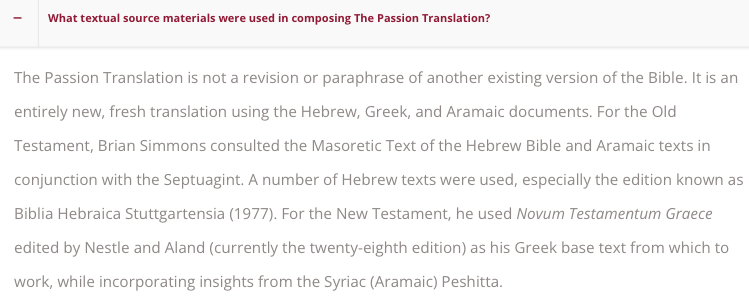
Simmons considers there to be three Hebrew Matthew ‘manuscripts’, of which one is ‘known as Shem-Tob’: 1

It may be noted in passing that Shem-Tob is not in fact a manuscript, but a version that exists in several manuscripts.
Simmons also makes reference to the ‘Du Tillet translation of Hebrew Matthew’:

It should be noted that Jean du Tillet, Bishop of Brieu, did not translate any Hebrew version of Matthew into English as the endnote suggests, but rather obtained in 1553 from the Jews in Italy a manuscript containing the Gospel of Matthew in Hebrew and published it in 1555. He did commission a translation into Latin.
The third prominent pre-modern Hebrew version of Matthew is that of Münster:

and it seems reasonable to assume that this is the third ‘manuscript’ that Simmons is referring to. It seems to follow that Simmons should be translating from one or more of these three versions. My attempt to clarify the matter through my email enquiry to Broadstreet Publishing of 14 June 2026 has not yet born fruit in the form of a reply or acknowledgment.
Matthew 5:4
In my article about Matthew 5.4, where Simmons has ‘wait upon the Lord’ instead of ‘mourn’, I showed that there was almost certainly an influence from Shem-Tob, which reads in English translation ‘Blessed are those who wait…’, while both Du Tillet and Münster read in translation ‘Happy are they that mourn…’:


From a cursory investigation, it became apparent that Simmons was depending on Shem-Tob in some other cases, but not in all. Sometimes, he was following Du Tillet, and sometimes neither. To try and understand what he was doing, and what ‘Hebrew Matthew’ he was referring to, I compared Simmons’ main text or endnote text with that of Shem-Tob, Tillet and Münster for the first 30 verses in Matthew where he references ‘[the] Hebrew Matthew’ in an endnote. In this article, I examine the other nine verses where the ‘Hebrew Matthew’ is a) significantly different from the Greek, and b) corresponds to Shem-Tob.
Matthew 4:23b
In the endnote to Matthew 4:23b:

the expression ‘the good gift’ in place of ‘the gospel’ occurs also in Shem-Tob, but not in Du Tillet or Münster:
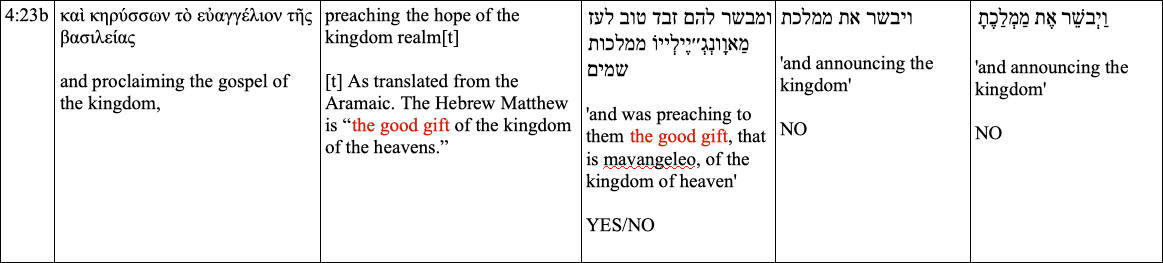
If Simmons were translating Shem-Tob’s text, however, his rendering would not be correct, since he has omitted the words לעז מַאוָונְגְ׳׳יֶילְייוֹ, rendered by Howard as ‘that is mavangeleo’, presumably because he was not certain of the meaning of ‘mavangeleo’. It is clearly related to the Greek word εὐαγγέλιον used in this verse. Perhaps it was simply a term for ‘gospel’, corresponding to our normal English versions?
Matthew 5:22
The second sentence of Simmons’ first endnote to Matthew 5:22 is hard to make sense of:

How could a clause in Hebrew or Aramaic be capable of carrying both these meanings? It is true that the Hebrew word כָּעַס in the Hifil can mean both ‘provoke to rage’ and ‘offend’ 2 One can also admit that the Hebrew word אָח (brother) could be interpreted by Simmons to mean ‘fellow believer’ in a New Testament context. But is it a brother/fellow believer who is provoked/offended, or is it the spirit of your brother/fellow believer? A word meaning ‘spirit’ (presumably רוּחַ) is either in the Hebrew text or it is not, and the same goes for the Syriac Peshiṭta.
None of the three Hebrew versions of Matthew 5:22a contain a word meaning ‘spirit’. But Shem-Tob (alone) does have כָּעַס in the Hifil, so that the idea is of angering another rather than being angry oneself:
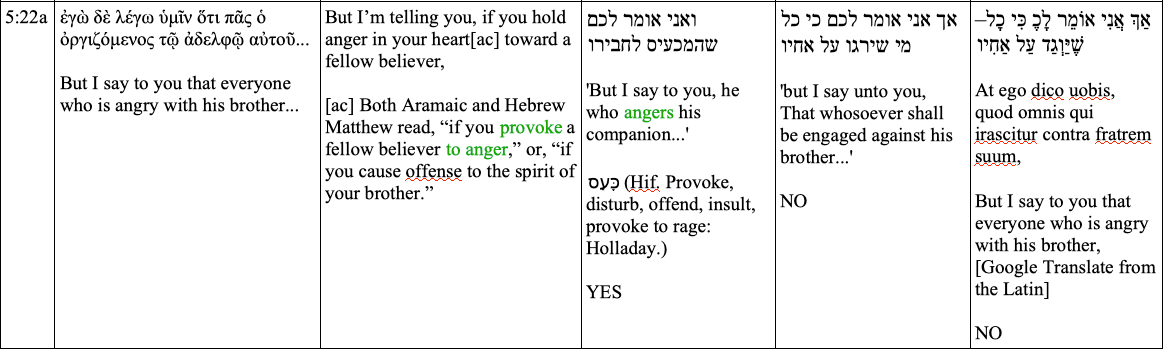
Simmons appears to be mistaken about the Peshiṭta, where the verb ܪܓܙ (rīš-gāmal-zayn) is in the Peal form (the equivalent of the Qal form in Hebrew), in which it means ‘to be angry, to be incensed’, so that it reads in translation (Murdock) ‘But I say to you, That every one who is angry with his brother…’, as in the Greek.
Matthew 5:39a
A particularly serious case of altering the teaching of the Lord Jesus Christ to conform to Shem-Tob’s version occurs in Matthew 5:39a where in place of ‘do not resist an evil person’, Simmons has ‘don’t repay an evil act with another evil act’:
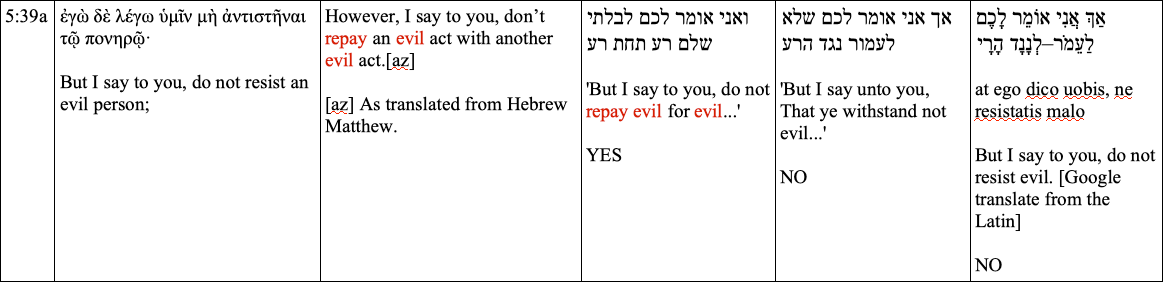
This is outrageous to remove an important teaching of the Lord Jesus Christ from a so-called bible ‘translation’ on the basis of a reading in a fourteenth century version. In a previous article, in a section entitled ‘Evaluation of Shem-Tob’s Matthew’, I showed that the overwhelming scholarly opinion is that Shem-Tob’s version is a translation from another language, be it Greek, Latin or even Catalan, and does not contain vestiges of an original composition in Hebrew. Why then prefer it to Nestle-Aland’s Greek edition, which Simmons claims is his ‘base text’?
Matthew 6:2
In Matthew 6:2, in place of ‘in the synagogues and in the streets’, Simmons has ‘in the streets and in the marketplace’, corresponding, apart from the singular form ‘marketplace’, to Shem-Tob’s ‘in the streets and in the marketplaces’:

The Peshiṭta reads here ܒ݁ܰܟ݂ܢܽܘܫܳܬ݂ܳܐ ܘܰܒ݂ܫܽܘܩܶܐ , baḵnūšāṯā waḇšūqe, ‘in the synagogues and in the marketplaces/streets’. It could only be said to be ‘translated from the Aramaic’ if endnote [c] applied only to ‘in the marketplace’. But to explain Simmons’ ‘in the streets’ in place of ‘in the synagogues’, it must also apply to this also, which is to be found in Shem-Tob. The endnote is therefore confusing at best.
שווקים in Shem-Tob is plural (‘streets’ or ‘marketplaces’), and there seems no good reason to change it to a singular.
Matthew 6:23b
In an endnote to Matthew 6:23b:

Simmons states that ‘Hebrew Matthew’ reads ‘All your ways are dark’, in place of ‘how great is that darkness’. Shem-Tob similarly has ‘all your ways will be dark’:
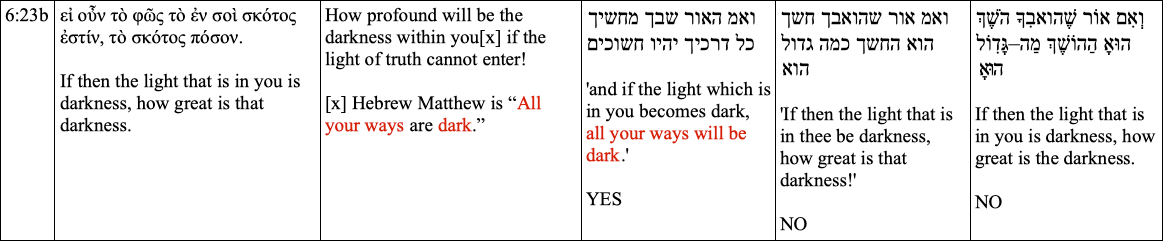
As in the previous cases, this reading is in Shem-Tob only. If ‘Hebrew Matthew is “All your ways are dark”‘, as Simmons claims, then it follows that ‘Hebrew Matthew’ is Shem-Tob in his parlance.
Matthew 7:11
In an endnote to Matthew 7:11:

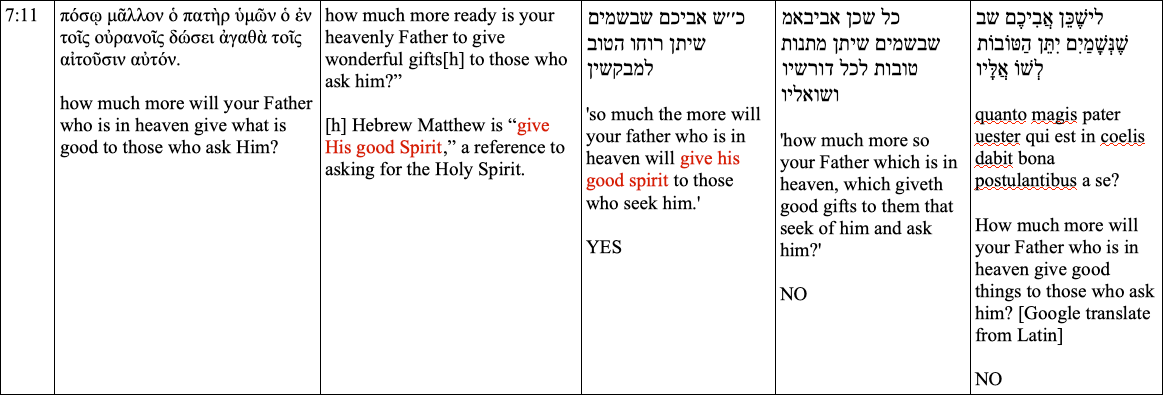
Simmons states that ‘Hebrew Matthew’ reads ‘give His good Spirit’ in place of ‘give what is good’. This appears to be taken from Shem-Tob:
Matthew 8:6
In Matthew 8:6, Simmons has ‘son’ in place of ‘servant’:

stating that this is translated from ‘the Aramaic and Hebrew Matthew’:

Both Shem-Tob and Du Tillet (but not Münster) have בני here meaning ‘my son’:

Simmons is wrong to say that the Greek word means ‘servant’. ὁ παῖς can mean ‘boy, youth’ or ‘son’ or ‘slave, servant’. The reason that servant is preferred by translators of the Greek text is that Luke in his account uses the word δοῦλος (slave, bondservant) for the same person. By following Shem-Tob and Du Tillet, Simmons creates a contradiction between the accounts that does not exist in the Greek text.
The Syriac word used in the Peshiṭta here is ܛܠܝܝ (ṭēt-lāmad-yūd-yūd) which is ܛܠܝܐ (ṭēt-lāmad-yūd-ālap), meaning ‘servant’ or ‘boy’, with yūd suffix, thus ‘my servant’ or ‘my boy’, where ‘boy’ could mean either ‘servant’ or potentially ‘son’. But the usual Syriac word meaning ‘son’ is ܒܪܐ (bēth-rīš-ālap), which would presumably have been used here if this had been the intended meaning of the translators of the Peshiṭta.
Matthew 9:2
In an endnote to Matthew 9:2:

Simmons gives ‘the Hebrew Matthew’ as ‘By the faith of the Mighty One your sins are forgiven’ in place of simply ‘your sins are forgiven’. Shem-Tob also has ‘It is by the faith of God your sins have been forgiven’:

‘The Mighty One’ is a possible translation of האל, Brown-Driver-Biggs giving ‘mighty one of the nations’ as the meaning of אֵל גוים.
Matthew 10:9
In an endnote to Matthew 10:9, Simmons gives ‘the Hebrew Matthew’ as ‘Don’t heap up silver and gold in your money belts’. Shem-Tob has two clauses joined by ולא (and not, nor), the first of which corresponds to Simmons’ ‘the Hebrew Matthew’ while the second does not, as it retains the idea of not taking any money:
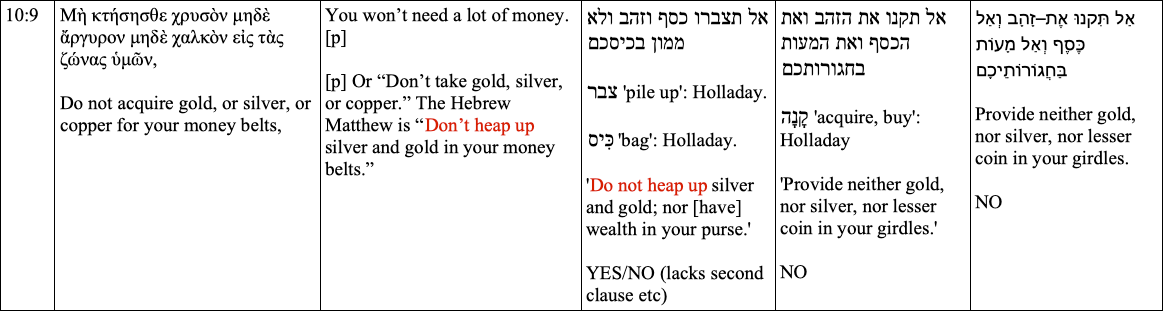
If Simmons were really translating Shem-Tob’s text, would he not translate the whole sentence?
By mixing Shem-Tob’s text with the Greek text (which also corresponds to Du Tillet and Münster here), Simmons changes the Lord Jesus Christ’s instructions to His disciples. If they were not to ‘heap up’ money in their belts, then it would be allowable for them to take a moderate amount of money. Simmons does indeed plant this different idea into his main text, as a tare in the midst of the wheat:
‘You won’t need a lot of money.’

Oh how comfortable! What a relief not to have to depend entirely on God!
Andrew Chapman
